
Introduction
In the injection molding and extrusion processes of thermoplastics, deviations in the flowability of raw materials often lead to batch scrapping of finished products. How can we accurately capture the “personality” of polymers in the molten state? TOPIL Flow-Master™ is more than just an MFI (Method for Rheological Analysis) tester; it’s the core of digital rheological assessment in the laboratory, ensuring that your raw materials meet stringent international standards before entering the production line.
Chapter 1: Industry Insights – Why is judging raw materials by touch a thing of the past?
In the plastic recycling and modification industry, materials from the same batch can exhibit vastly different processing behaviors due to micro-variations in molecular weight distribution. From a seasoned material analysis perspective, we know:
- Flash and Short Shots: Often caused by MFR (Melt Mass-Flow Rate) being too high or too low.
- Recycled Material Control: The flowability of regrind is notoriously unstable; lacking precise testing leads directly to downtime and material waste.
The TOPIL Flow-Master™ was engineered to replace “empiricism” with data, allowing production managers to understand the flow characteristics of every batch before power-on.
Chapter 2: Core Technology—The Precision of 7″ Smart Touch & Dual Temperature Control
As the benchmark for industrial-grade MFI equipment, the TOPIL Flow-Master™ achieves breakthroughs in three technical dimensions:
- Precision Thermal Control: Thermoplastics are extremely temperature-sensitive. We utilize a dual-heating element design to ensure temperature uniformity within the cylinder is controlled within ±0.2°C, effectively eliminating data drift caused by thermal gradients.
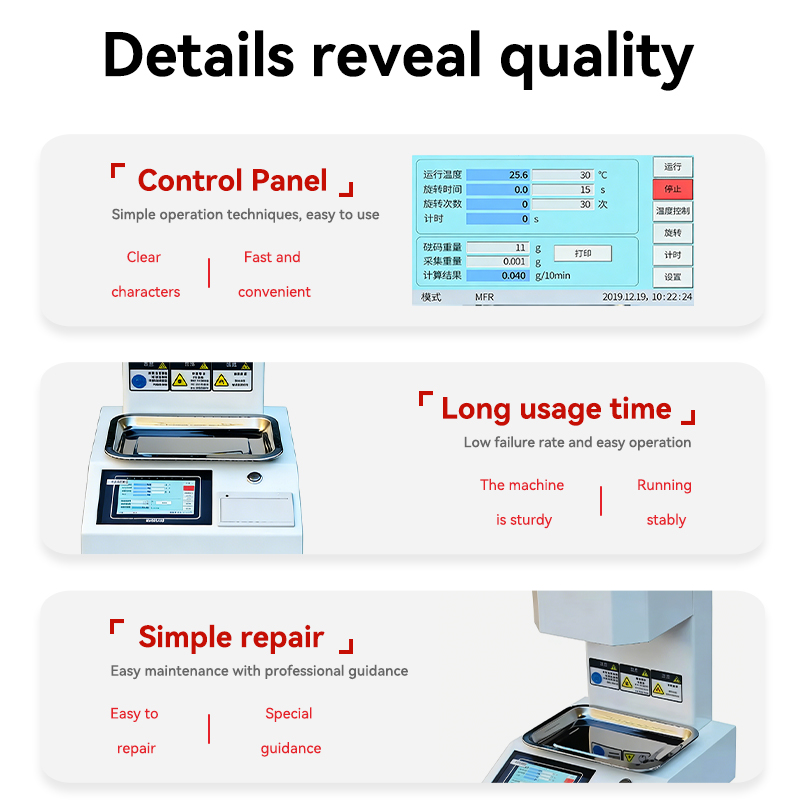
- 7-Inch Intelligent Interaction: Moving beyond complex physical buttons, the intuitive touchscreen interface supports real-time curve displays. Operators simply input density parameters, and the system automatically switches between MFR (Mass Method) and MVR (Volume Method).
- Displacement Capture Tech: An integrated high-precision optical displacement sensor (for MVR testing) captures minute changes in melt volume with a data resolution of 0.001mm.
Chapter 3: Compliance—A “Material Passport” Recognized Globally
To ensure your products pass through the global supply chain without friction, the testing logic of the TOPIL Flow-Master™ is fully compliant with authoritative international standards:
| Test Parameter | Application Scenario | Reference Standard | Core Value |
| MFR (Mass) | Standard plastics (PE/PP/ABS) | ISO 1133 / ASTM D1238 | Establish basic raw material entry files |
| MVR (Volume) | Materials with impurities/high flow | ISO 1133-2 | Evaluate complex rheology & molecular stability |
| Multi-Load Test | Specially modified engineering plastics | Industry Custom | Simulate behavior under different shear rates |
Chapter 4: Data Reliability—The Final Barrier Against “Human Error”
In Quality Control (QC), Trustworthiness stems from an obsession with detail:
- Automatic Cutting System: The system provides alerts and performs automatic cutting, eliminating the weight deviations caused by manual operation.
- Easy-Clean Architecture: The cylinder and piston rod are treated with nitrided steel hardening, making them wear-resistant and extremely easy to clean, which prevents cross-contamination between samples.
- Data Traceability: Supports the storage of multiple historical test groups. Data can be exported via USB or micro-printer to create a closed-loop quality tracking system.
Chapter 5: Expert Viewpoint—Rheological Advice for “Smart Manufacturing”
Purchasing a TOPIL Flow-Master™ is just the first step. Our technical experts recommend:
- Regular Calibration: Use Certified Reference Materials (CRM) quarterly to calibrate the equipment.
- Cost Optimization: Through MVR testing, you can more accurately control the blending ratio of recycled materials, significantly reducing raw material costs while maintaining high quality.