In logistics and warehousing, transit damage caused by cardboard box collapse is a major threat to business profits. Relying solely on experience to judge box strength is no longer safe. This article will analyze from a packaging mechanics perspective why TOPIL Fortis-Box™ is the last line of defense to ensure your products remain stable under heavy pressure.
Chapter 1: Industry Pain Points – Why do “seemingly thick” cardboard boxes still collapse?
As a packaging engineer, you may have encountered this dilemma: despite using high-grammage corrugated paper, the cartons still suffer severe compression deformation at the bottom of shipping containers.
This is the consequence of lacking quantitative data on BCT (box crush strength). Fluctuations in temperature and humidity, stacking time, and even the instantaneous impact of forklifts can all lead to a decrease in the physical strength of the cartons. Relying solely on physical thickness is misguided; true reliability comes from precise simulated crush tests in the laboratory.
Chapter 2: Core Technology – How does Fortis-Box™ achieve micron-level crush capture?
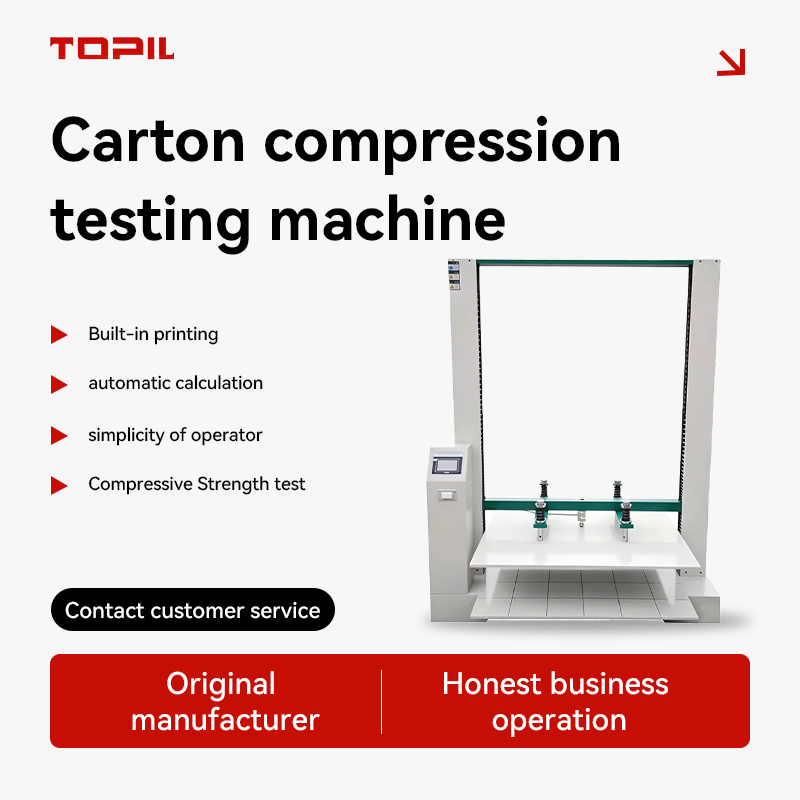
The TOPIL Fortis-Box™ is not your average press; its core technical specifications represent the highest level of industrial-grade testing:
High-sensitivity Load Cell: Equipped with a high-precision load cell, it detects minute packaging deformations, ensuring that the error in the collected crush peak data is less than 0.5%.
Intelligent PLC Control System: Employs an industrial-grade programmable logic controller, supporting multiple modes such as constant pressure, constant displacement, and constant speed, meeting the non-standard testing needs of different materials (such as corrugated paper, honeycomb panels, and plastic turnover boxes).
Precision Ball Screw Drive: Ensures the absolute horizontal operation of the pressurization platform, avoiding spurious deviations in test data caused by mechanical misalignment.
Chapter 3: Authoritative Interpretation – From BCT to Stacking, Mastering International Packaging Standards
To ensure your products successfully pass international inspections and buyer reviews, TOPIL Fortis-Box™ comes pre-loaded with a variety of mainstream testing algorithms, perfectly compatible with the following standards
| Test type | Test objective | International Standards | Key Indicators |
| BCT compressive strength | Instantaneous extreme strength test | ISO 12048 / ASTM D642 | Maximum fracturing force (kN) |
| Stacking test | Simulating long-term storage pressure | GB/T 4857.3 | Constant pressure and deformation rate |
| Crush Resistance | Edge/Flat Compressive Strength | TAPPI T804 | Yield point judgment |
Chapter 4: Cost Reduction and Efficiency Improvement – Using Data to Drive Redundancy Removal in Packaging
In today’s cost-constrained world, over-packaging is also a form of waste.
Material Optimization: Real-world testing data from Fortis-Box™ allows you to accurately determine the required number of corrugated layers to reach a safe threshold, thereby reducing raw material procurement costs.
Data Traceability: Test results can generate reports in real time or be exported to your enterprise ERP system, providing a digital record of packaging quality for each batch.
Zero Damage Guarantee: “Stress testing” is conducted before products leave the factory, reducing the loss rate during transportation to below 0.1%.
Chapter 5: Expert Selection – Why do leading global laboratories choose TOPIL?
Choosing TOPIL Fortis-Box™ means more than just a machine; it’s a complete packaging safety solution:
Safety Protection: Features over-range protection, emergency stop switch, and limit protection to ensure the safety of laboratory operators.
Wide Range Adaptability: From small express boxes to extra-large cartons, the Fortis-Box™ series offers a variety of customized test space sizes.
Global After-Sales Support: Professional calibration services ensure your equipment always meets ISO laboratory accreditation requirements.